
Basic structure of decision tables
Basic structure of decision tables
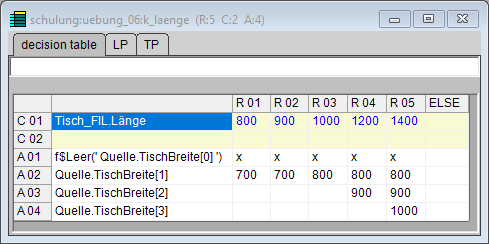
Decision table
The conditions are located in the upper part of the table (condition part), and the actions in the lower part (action part).
On the left are the terms that characterize the conditions and actions ("if"-"then"), and on the right the individual statements are combined into rules, which are numbered in ascending order.
An occurring combination of conditions is thus associated with the appropriate set of actions.
Each decision table is characterized, and can be addressed, by a table name.
Example:Possible table widths for a specified table length
A table that is 800 or 900 long can only be 700 wide.
A table that is 1000 long can only be 800 wide.
A table that is 1200 long can be either 800 or 900 wide.
A table that is 1400 long can be 800, 900, or 1000 wide.
The example includes the following conditions and actions:
Conditions :
Table length = 800
Table length = 900
Table length = 1000
Table length = 1200
Table length = 1400
Actions :
Table width = 700
Table width = 700
Table width = 800
Table width = 800 or 900
Table width = 800, 900, or 1000